Finding advanced Spanish activities that actually balance authentic culture with meaningful language input can feel like a challenge. When you are drowning in daily lesson planning ideas and looking for fresh Spanish resources and worksheets to add to your rotation, nothing beats talking to a colleague who has spent years testing strategies in a real high school Spanish classroom to see what actually works.
Today, I am excited to introduce you to Tonya from Language at Play. Tonya teaches high school Spanish in Kentucky and has over two decades of classroom experience. From her accidental route into the profession to her favorite Spanish classroom games, Tonya has figured out how to keep upper-level students focused, comfortable, and acquiring language.
If you're looking for practical, low-prep ideas for advanced Spanish class activities and realistic strategies for creating a supportive classroom environment, you'll appreciate Tonya's approach.
More...
Disclosure: This post may contain affiliate links. As an affiliate for Amazon and other companies, I earn from qualifying purchases. This means that if you click on a link and make a purchase, I may earn a small commission at no additional cost to you.
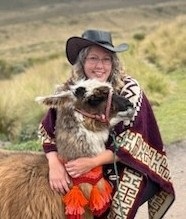
"My best tip for setting up a classroom that supports language learning is to get to know your students well. The sense of community is important."
An Unexpected Path to the Spanish Classroom
Some educators know they want to teach Spanish from day one, but Tonya's career started with a love for travel and a completely different language.
"I became addicted to traveling in college and eventually decided to move abroad," Tonya says. "I went to school in Italy where I lived and worked in Rome as an interpreter for a travel agency. When I moved back to the States, I decided to become an Italian teacher."
But life had other plans.
After returning to the United States, she continued pursuing her goal of becoming an Italian teacher...
At the time, Illinois—where she grew up—only offered endorsements in Italian, but she was advised to learn Spanish if she wanted to pursue a career as a world language teacher.
So she returned to university to study Spanish and took advantage of opportunities to travel and study in several Spanish-speaking countries. Eventually, she moved to Kentucky, where she began her career as a Spanish teacher.
That background in travel still drives her teaching.
If she weren't in the classroom today, Tonya notes she would likely work as a travel agent or host a travel show. For her, knowing the language is what makes travel personal and allows you to truly understand local culture.
Meet the Teachers: Series Spotlight
Love learning how other secondary teachers run their classrooms? Here are some of my other Meet the Teacher interviews! Check out these other posts for more inspiration, routines, and low-prep ideas:
Advanced Spanish Class Activities: Food & Social Issues
As a self-proclaimed foodie, Tonya frequently builds culinary traditions into her high school Spanish activities. She takes cooking classes and food tours during her travels and brings those experiences back to her students, organizing food days or surprising her classes with authentic dishes she learned to make abroad.
But she also likes diving into deeper social issues. In her AP Spanish Language class, she teaches a unit built around the movie También la lluvia and leads a student-driven Socratic seminar after viewing the film—an activity she adapted from Spanish teacher Kara Jacobs.
These advanced Spanish class activities challenge students to use the language in more analytical ways, though Tonya admits she was incredibly nervous the first year she tried it. Her AP class includes a diverse mix of non-native, heritage, and native speakers. She worried the non-native students would find the environment too stressful, and that her heritage speakers—who happened to be her youngest students—might struggle with the format.
But the risk completely paid off.
Tonya was incredibly proud of the depth of their discussions, and the students loved it, too. "Several students told me afterward it made them nervous at first," Tonya says, "but it ended up being fun." Now, it is an activity she looks forward to every year as a space where her students truly shine.
Tonya's Strategy: Connection Before Curriculum
Establishing a cohesive Spanish classroom community is essential for supporting language learning. Because Tonya designs her advanced Spanish class activities for upper levels rather than Spanish 1, her classes often include students from four different grade levels, meaning many students find themselves in a room where they may not know anyone else.
To help everyone feel comfortable working together later on, Tonya focuses heavily on building relationships during the first few weeks of school:
- Learning names early: Tonya uses student pictures from Infinite Campus to try and learn her students' names before the school year even starts.
- Student-centered mini-units: Though she notes this might be more difficult at the Spanish 1 level, Tonya spends the first few weeks of class designing mini-units centered entirely around her students to learn about their interests.
- Turning student life into class input: As the students share details about themselves, Tonya builds the lesson activities directly around them—using personalized readings and true/false Spanish games.
This approach helps Tonya learn about her students, but just as importantly, it lets the students learn about each other so they feel more comfortable collaborating as the year goes on.
Low-Prep, High-Input Spanish Games and Activities
To keep her classes dynamic, Tonya loves to vary her activities. When she looks across her school year, a few staple strategies always come to mind for developing different skills: Free Voluntary Reading (FVR) for reading, Tabú or Rock, Paper, Scissors for speaking, and Write and Discuss for writing.
But what happens on those days when planning time is short, and you only have 15 minutes to pull a class together?
Tonya leans directly into interactive, high-input listening games that require absolutely zero prep. Her two absolute favorites are:
- The Whiteboard Q&A Game: Tonya asks questions in Spanish about a story, novel, or Spanish-speaking country the class is currently studying. Students work in pairs, writing down their answers on handheld whiteboards.
- The "Pop-Up" Game: A highly interactive listening game she first discovered through Claudia Elliott’s Growing with Proficiency blog.
Both of these Spanish classroom games are fantastic because they provide massive amounts of listening input, require no prior printing or copying, and keep the energy in the room high.
Why These Activities Work So Well
One thing that really stood out to me about Tonya's recommendations is how simple they are to implement.
I love that Tonya features these two activities because they highlight a massive truth in language teaching—"low-prep" doesn't mean "low-value." In fact, whiteboard Q&A and the Pop-Up game are powerful precisely because they put the focus back on pure, interactive listening. Pair work on whiteboards lowers the stakes for individual students, and it gives you instant, visual formative assessment without you having to go through piles of papers and worksheets.
If you don't already have a class set of dry-erase boards, they're one of the best investments you can make for your classroom. They're super versatile and make it easy to get the whole class engaged. You can grab a pack of 36 hand-held whiteboards here to get set up for this game, or check out my full breakdown of essential resources for Spanish teachers for more tools and gadgets you need in your classroom.
Spanish Teacher "This or That" with Tonya
Next up, here are some quick-fire questions to get a glimpse into her teacher life and preferences
- Your go-to for real language: Movies/Videos or Podcasts? → Movies and Videos!
- Dream vacation: Winter in Argentina or Summer in Spain? → Winter in Argentina.
- You get new ideas from: Social Media or Professional Development? → Social Media.
- In-class engagement strategy: Brain Breaks or Games? → Games.
- Favorite cultural dish: Paella or Tacos? → Arepas!
Diving Deeper into Spanish Novel Units
Since novel units are one of Tonya's specialties, I asked her what she would recommend for teachers who want to get started.
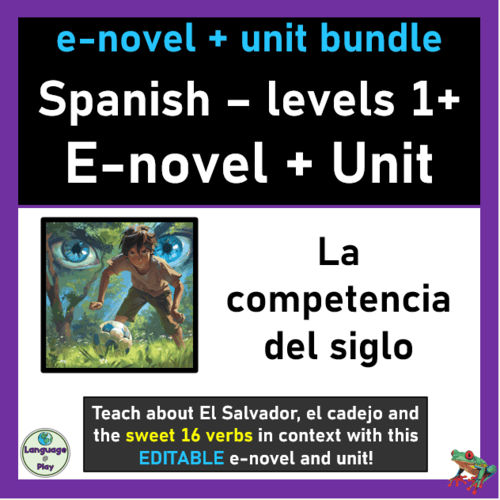
This comprehensive teacher's guide is designed to accompany a short e-novel set in El Salvador, featuring a compelling plot that seamlessly blends a love for soccer with the Central American legend of the Cadejo. It is the perfect cultural hook for high schoolers.
Spanish Reading 1 E-Novel Activities
High-Frequency Input: Focuses heavily on the "Sweet 16" verbs to deliver rich, comprehensible input.
Confidence-Building Activities: Specifically scaffolded to help novice and intermediate learners process the text smoothly.
Zero-Prep Roadmap: Saves hours of planning by providing a clear, ready-to-use guide for your class.
Free Spanish Resources for Your Classroom
Now that you've gotten to know Tonya a little better, she's generously offering a free resource you can try in your own classroom.
A Freebie from Tonya
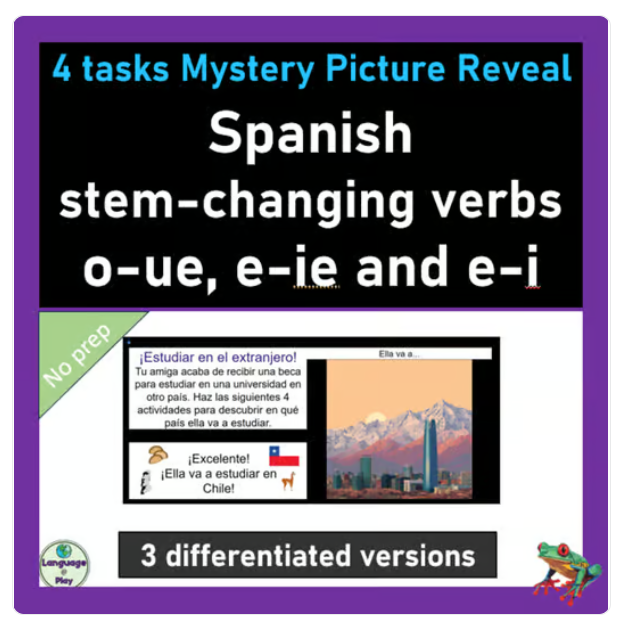
This digital mystery picture activity gives students practice with o→ue, e→i, and e→ie verb conjugations while providing instant feedback through a self-checking Google Sheets format
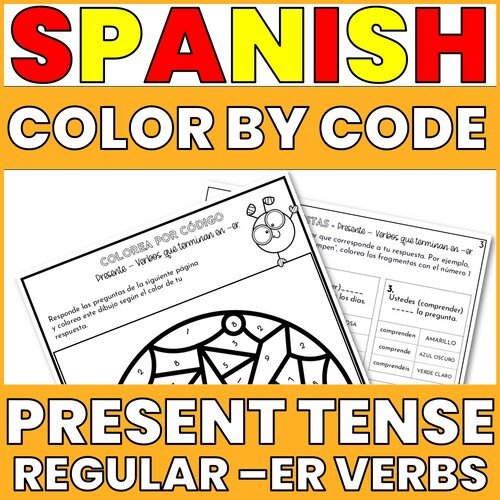
A Freebie From Me: Present Tense Regular -ER verbs
If you're looking for another engaging way to review Spanish conjugations, this color-by-code activity is a great option.
Learners conjugate present tense verbs and use their answers to complete a colorful picture, making grammar practice both engaging and rewarding.
Connecting Culture and Play in Your Classroom
A huge thank you to Tonya from Language at Play for sharing her classroom experience, community-building strategies, and low-prep game ideas with us. Her journey reminds us that the best language classrooms are the ones where students feel known, comfortable, and actively engaged.
If you appreciate her focus on making language acquisition active, low-stress, and deeply connected to culture, be sure to explore the rest of her creative, input-driven resources at her Teachers Pay Teachers store, Language at Play.
Find More Time-Saving Spanish Resources and Worksheets
If you want more ready-to-go, high-engagement materials to simplify your daily lesson planning, head over and explore my store Spanish Worksheets and More. It is full of no-prep and low-prep Spanish resources and interactive activities to keep your students completely engaged!
Now, I'd love to hear from you! What are your absolute favorite high school Spanish activities when you need a quick, zero-prep lesson that still delivers great target language input? Do you use whiteboards as much as Tonya and I do?
0 comments