Teaching telling the time in Spanish (¿Qué hora es?) doesn't have to mean endlessly drilling clock faces on a whiteboard. When students transition from basic hours (Es la una) to trickier structures like y media, y cuarto, or subtracting minutes with menos, interactive practice is essential for building real proficiency.
If you are looking for low-prep, highly engaging ways to reinforce time vocabulary in your Spanish classroom, these four no-prep activities (some printing and cutting involved) will get your students actively listening, processing, and speaking.
More...
Disclosure: This post may contain affiliate links. As an affiliate for Amazon and other companies, I earn from qualifying purchases. This means that if you click on a link and make a purchase, I may earn a small commission at no additional cost to you.
Why Teaching Time (and Numbers!) in Spanish Matters
Learning how to tell the time in Spanish is a fun way to practice the numbers in Spanish. And it's also a practical, real-world skill for Spanish 1 and 2 students. They'll need to use it for talking about their daily routines, traveling, but also to make arrangements with their Spanish friends (even if said friends are always late... Yes, a bit stereotypical, but I swear you have to tell my uncle to turn up 30 minutes earlier or he'll be late!).
Telling time requires students to instantly recall numbers 1 through 60 without pausing to mentally translate. Before diving into full time phrases like "Son las ocho menos veinte", having a strong foundation in Spanish numbers is essential. If your students are still rusty on their digits, here are some Spanish numbers activities they'll enjoy.
Spanish Telling The Time Color-by-Code
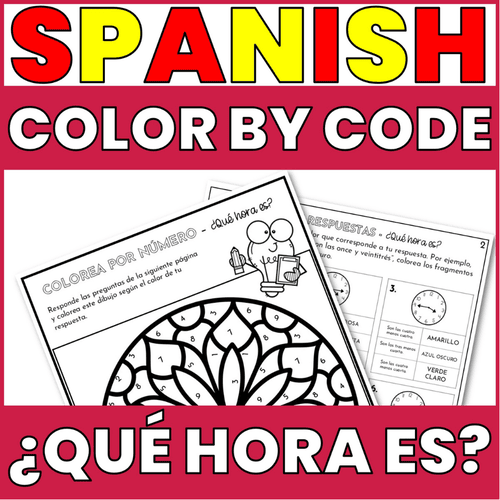
Color-by-code worksheets combine short reading comprehension tasks with visual recognition and get your students actively interacting with the worksheet. What's more, coloring this mandala design also offer a relaxing mindful experience that keeps middle and high school students fully engaged without feeling childish.
With differentiated options and Spanish and English instructions so you can choose the right version for your students.
How It Works
Students get the telling the time in Spanish coloring page and the answer sheet. For each question they must choose from the multiple choice questions and then color the image with the color under the answer they chose.
Most color by number or color by code activities are self-checking, as the students see if a color looks out of place as they work, but they´re also super easy for you to check at a glance. A quick look and you´ll see if the colors match the color key.
TIP: Get students to work together and check each other´s work as they color in.
Why Teachers Love It
- Zero Prep & Ready to Print: Simply copy and hand out for an instant practice session.
- Built-In Differentiation: Features three differentiated answer sheet versions so you can easily adapt the difficulty for mixed-ability groups or different grade levels.
- Flexible Implementation: Works as a calm-down activity, fast-finisher task, sub plan, homework, or language station.
JOSEPHINA
"My students were engaged and happy because they were able to tell the time in Spanish and understand it more in English too. It aligns with the standards and can be easily adapted to my curriculum. I was able to include it as part of my lesson plans. I loved how easy it was to grade using it. Keep making more like this."
¿Qué hora es? Secret Picture Tiles Printable or Digital Puzzle
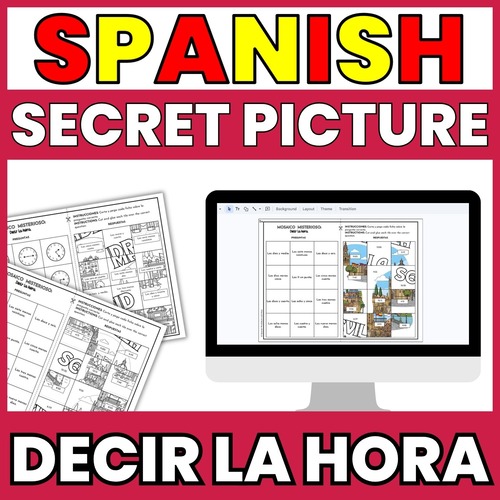
This secret picture tiles puzzle is the perfect hands-on activity to practice telling the time in Spanish class and is designed for tactile and kinesthetic learners. It is an engaging alternative to traditional Spanish grammar worksheets whether used in paper format or as a digital assignment.
How It Works
Students match Spanish time questions with corresponding time tiles. As they match each pair, they cut, paste, and assemble the puzzle pieces in the correct grid order (or drag and drop in Google Slides/PowerPoint) to rearrange the image.
Why It Works
It gives kinesthetic and visual learners a hands-on way to interact with time vocabulary. The secret image serves as instant visual feedback: if the picture looks jumbled or doesn't align correctly, students immediately know to go back and re-evaluate their time translations. And the puzzle also works as built-in help, as students can see visually where the tile should go.
Why Teachers Love It
- Printable or Digital: Print it for a hands-on cut-and-paste activity with scissors and glue, or assign the digital slides via your LMS for a paperless lesson.
- Instant Self-Checking: Students catch and correct their own errors without needing constant teacher validation.
- Flexible: Comes with two versions and with bilingual instructions, they´re perfect for sub plans an for 100% independent practice.
TIP: Keep a few of these in your choice folders for students to use on their own time or assign as easy homework activities.
Telling The Time In Spanish With Bingo Games
Bingo games or loterías are perfect to practice and review telling the time in Spanish. It is a classic, whole-class listening comprehension activity that turns listening practice into a fun review game. It challenges students to quickly translate spoken Spanish times into digital numbers or clocks on their game boards, reinforcing listening skills in a fast-paced environment.
How It Works
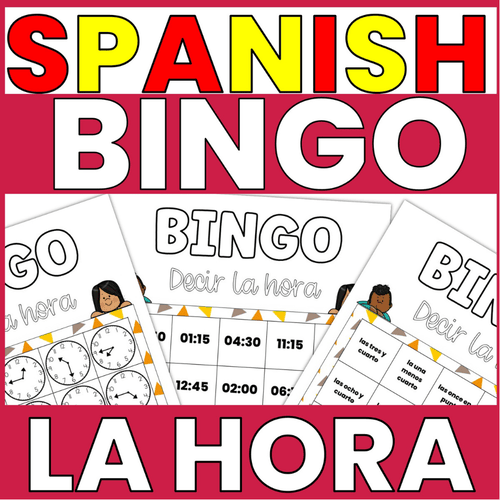
In this La Hora Bingo Game, there are three options so you can choose from analog, digital or the time in Spanish. Then you call out the time phrases in Spanish for listening comprehension. Or you may call them in English for a little extra challenge. Students mark the time on their boards and call "Línea" for a line, and "Bingo" when they have a full board.
Why It Works
It trains the brain to process spoken Spanish time directly into numeric concepts and makes a repetitive listening comprehension into an easy low-risk, competitive game that keeps the entire class attentive.
Why Teachers Love It
- Easy to Prep & Infinite Replay Value: All you need is to print and copy the boards and the calling card list and students need a pen or marker.
- Universal Student Buy-In: Every student knows how to play Bingo, so zero instruction time is wasted explaining game mechanics.
- Great Speaking Practice: Once students get comfortable, the winning student becomes the caller for the next round.
TIPS:
- Call out time phrases at different speeds to help beginners build confidence with listening comprehension.
- Print and laminate so you can easily reuse the boards, or use dry erase plastic sleeves and dry-erase markers.
Reviewing La Hora In Spanish With An I Have Who Has Loop Game
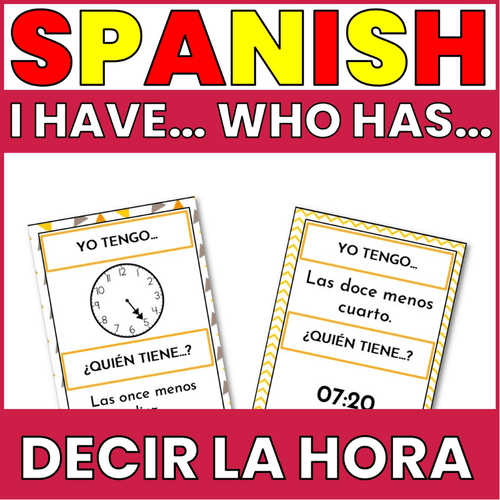
Another interactive activity for teaching the time in Spanish is an "I Have, Who Has?" game (Yo tengo, ¿Quién tiene?). This game is a continuous chain activity designed to get the whole class reading, listening, and speaking aloud. Each student holds a card with a time answer and a new time question, creating an interactive speaking loop that reviews time vocabulary from start to finish.
How It Works
Divide your class into groups and pass out the cards. Each card feature an statement and a follow-up question in Spanish (e.g., "Yo tengo las 2:30. ¿Quién tiene son las cinco y cuarto?"). The student with 5:15 responds: "Yo tengo las 5:15. ¿Quién tiene las tres menos cuarto?" and so on, until all the cards have been read and they go through the whole loop.
Why It Works
It forces every student in the room to maintain active listening because anyone could hold the matching card for the prompt currently being read. It bridges reading, listening, and oral pronunciation and the repetition makes it easier for students to learn grammar structures or vocabulary without feeling boring.
Why Teachers Love It
- Gets Everyone Speaking: Even shy students get a moment to speak aloud to the group.
- Quick Warm-Up or Exit Ticket: Takes only 5 to 10 minutes to run, making it an ideal lesson opener or wrap-up activity.
- Gamified Timing: You can time the class on a stopwatch to make it a cooperative game where they try to beat their previous class record.
- Flexible: Use as a whole class or group activity.
Stop Drawing Clocks And Marking By Hand!
Let's be real: the last thing you want to do after a full day in the classroom is spend your entire evening hand-drawing clock faces or marking Spanish telling the time worksheets with tiny clock faces that make your eyes cross.
Getting your middle or high school students fluent in decir la hora should be engaging for them and stress-free for you.
You have options, get a self-checking desk activity for a chaotic Friday afternoon, a kinesthetic puzzle for your hands-on learners, or a lively whole-class game that gets everyone speaking from my store and save on prep time!
Grab one of these activities or, grab my telling the time Spanish bundle, or if you're looking for something else, browse my Spanish Worksheets And More store for more activities to teach and practice the time in Spanish.
0 comments