How many times have you searched for Spanish songs for a specific topic or grammar point and ended up spending hours on YouTube? Searching for the perfect musical Spanish bell ringer or brain break usually leads to a frustrating rabbit hole. If you’re tired of tracks that are too fast, too childish, or not school-appropriate, there’s a better way.
We’ve all been there—scrolling through playlists during our lunch break, hoping for a miracle hit that perfectly matches our Spanish lesson plans. If you've always wanted a library of Spanish songs for class that hit exactly the vocabulary you're teaching, it’s time to stop searching. Let me show you how to create custom, 30-second tracks for your starter tasks, brain breaks, and transitions in minutes.
More...
Disclosure: This post may contain affiliate links. As an affiliate for Amazon and other companies, I earn from qualifying purchases. This means that if you click on a link and make a purchase, I may earn a small commission at no additional cost to you.
Why Music Actually "Works" (Without the Boring Theory)
We know music is fun, but in a Spanish class, it’s a total survival tool. Here’s why you need to start making your own:
- The "Earworm" Effect: You know when a song gets stuck in your head for three days? That’s what we want for the irregular yo forms. When a tricky grammar point has a melody, it sticks in their brains without them even trying.
- Waking Up the Room: Sometimes the energy is just flat. Music is the fastest way to change the "vibe" without having to give a motivational speech.
- Real-Life Rhythm: Even a 30-second snippet helps students hear how Spanish actually sounds—the flow, the speed, and the accent—without the overwhelm of a four-minute ballad.
Using these 30-second tracks is a great way to model native-like flow. If you're looking for more ways to help your students master their accent, check out best tips to teach Spanish pronunciation.
3 Ways to Use AI Music for Spanish Bell Ringers and Brain Breaks
You don't need a full album. For most Spanish classroom activities, shorter is actually better. Here are three ways I’m using these custom tracks:
1. The "Clean-Up" Transition Jingle
Transitions are usually when the chaos happens. Use a specific 30-second jingle to signal it’s time to switch gears.
- The Vibe: A fast-paced Spanish Ska or Punk beat.
- The Task: Students have until the end of the song to put away markers and get into their next groups. It turns a boring transition into a race against the beat.
2. The "Friday Energy" Spanish Brain Break
When you see those glazed-over eyes halfway through a block period, it's time for a Spanish brain break.
- The Vibe: A high-energy Salsa or Reggaeton beat.
- The Task: Play a 30-second track and have everyone stand up for a "Freeze Dance" or just a quick stretch. It’s a 30-second reset that keeps them in "Spanish mode" while letting them move.
3. The "Stealth" Vocab & Grammar Review
This is my favorite. You can write lyrics that use the exact list of words you want.
- The Vibe: Clear Acoustic Pop or Lo-fi so the words are easy to hear.
- The Task: Write a song about food likes and dislikes with two unlikely items they hate. Play it as a Spanish starter task and ask: "What foods does the singer hate?" It’s a targeted listening drill that feels like a song, not a test.
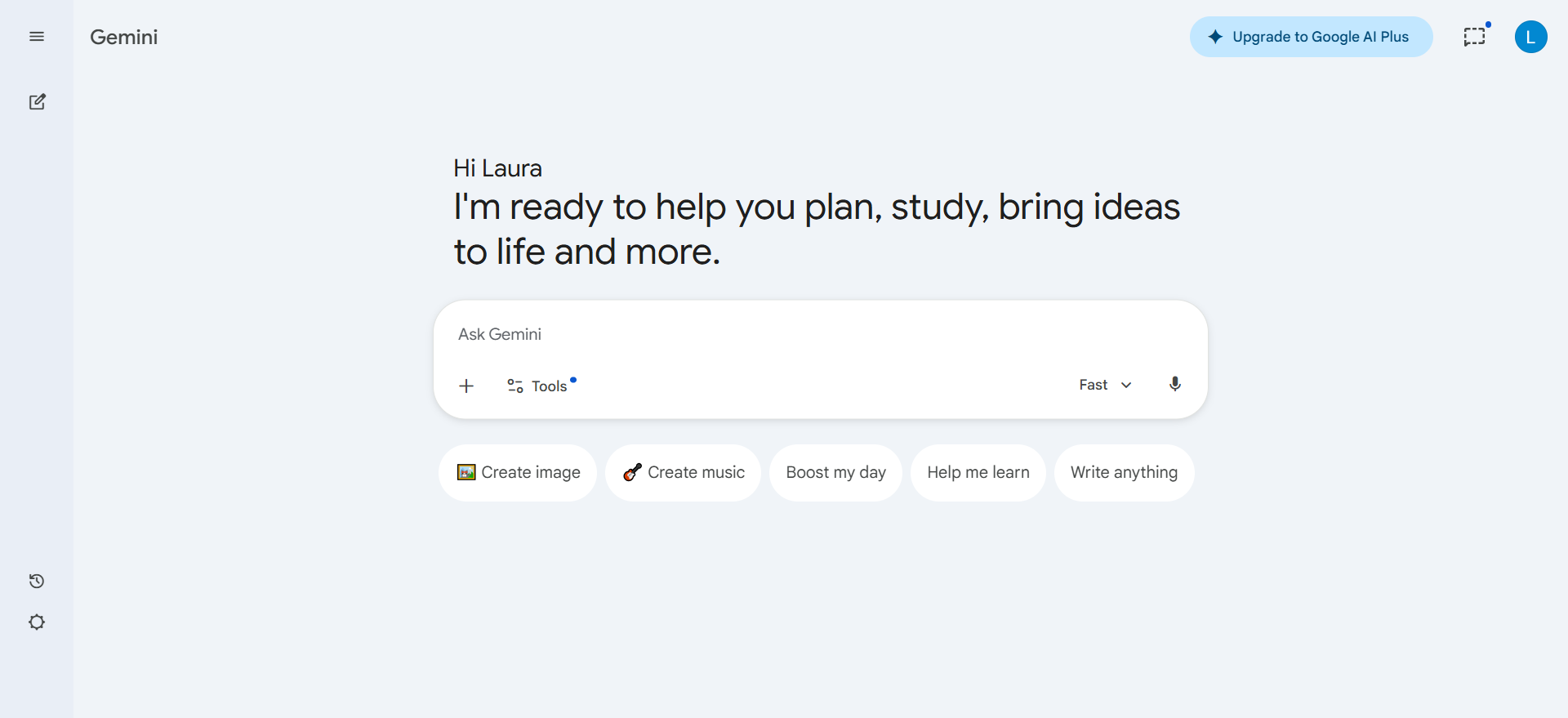
How to Make Your Own (No "Songwriter" Skills Required!)
Ready to try it? You don't need to be a musician or even a poet.
To get the best results for your Spanish classroom activities, you have to think like a mini-producer. Lyria is amazing, but it needs a little direction to make sure the song is actually usable for a room full of students.
Genre or Style (The "Vibe"):
Choose a genre that fits the mood of the activity or the topic.
- For Brain Breaks: Go for high-energy, rhythmic styles like Reggaeton, Salsa, or Spanish Ska. These get students moving and shaking off the "mid-period fog."
- For Starter Tasks (Bell Ringers): Use Lo-fi, Acoustic Pop, or Bossa Nova. These are "brain-friendly" genres that allow students to focus on the lyrics without being overwhelmed by loud instruments.
- For Storytelling/Culture: Match the music to the theme. Teaching about Argentina? Use Tango. Discussing a sad story? A Bolero or a slow Balada works perfectly.
PRO-TIP: Choose Your Genres Wisely
Be specific with your style tags! While "Punk Rock" or "Reggaeton" can be high-energy, they occasionally pull in "authentic" (read: inappropriate) slang or swear words from their training data. For the safest classroom results, try adding tags like "Kid-friendly," "Educational," or "Clean Lyrics" to your prompt. If a track comes back too "spicy," just hit regenerate!
Theme (The "What"):
Here is how you can "direct" the content to make sure it’s a perfect fit for your Spanish lesson plans:
- Specify the "Level" or Grade: Tell Lyria exactly who the song is for. This is the fastest way to get comprehensible input that doesn't overwhelm your students.
- Example: "Use simple vocabulary appropriate for Spanish 1"
- Example: "Write for an Intermediate Spanish level; avoid complex literary terms."
- Define Your "Must-Have" Vocabulary: Don't leave the vocab to chance! If you’re doing a unit on "The House," give Lyria a short "word bank" to include in the lyrics.
- Prompt Tip: "Write a song about a visit to a friend's house. Must include these words: la sala, la cocina, la habitación, el pasillo, and el garaje."
- Set the "Grammar Guardrails": This is a must for focused Spanish classroom activities. You can actually restrict the AI to the tense you are currently teaching for higher levels.
- Prompt Tip: "Write a story about a summer trip to Mexico. Use only the Preterite tense. Do not use the Imperfect or Subjunctive."
Tempo (The "Speed"):
This controls the "processing time" for your students. The tempo depends on what type of music style you've chosen, but you can also make sure it's at the right speed for your students by telling it to use slow, medium or fast tempo, or instruct it so it's "appropriate for beginners" or the level you're teaching.
But don't forget these are only 30 seconds, so slowing the tempo too much means there won't be as much content.
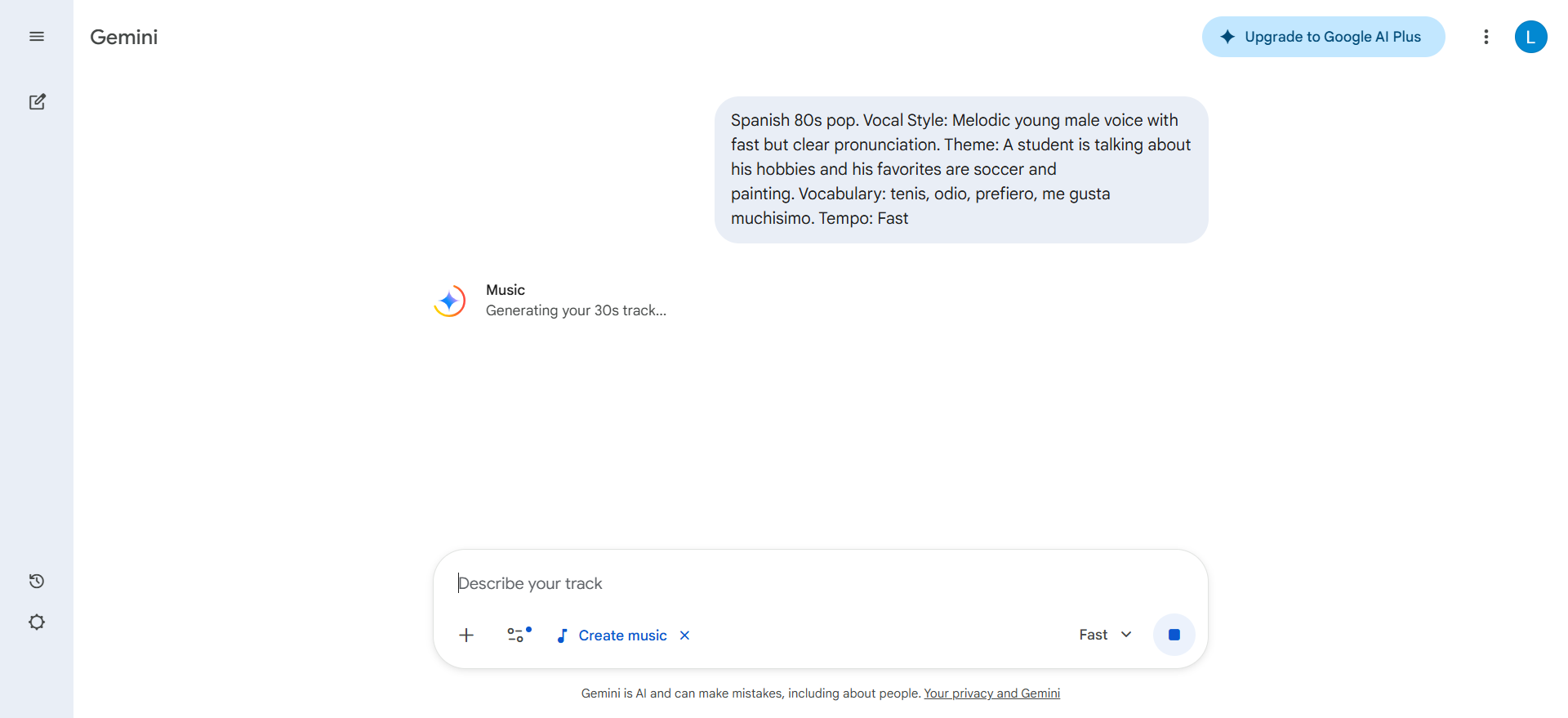
Example prompts:
These are a couple of prompts and the actual results I got. Bear in mind that I started with very simple prompts first and added more detail as I learned how to "nudge" Lyria to produce exactly what I needed. I recommend keeping it as simple as possible at first, then tweaking as you go. Once you've played with the tool for a bit and get a feel for the results, you’ll be able to get exactly what you want in just a couple of attempts!
Spanish Pop song. Male voice, very clear. Theme: Looking for school supplies at 8:10 AM. Use Spanish 1 appropriate words like mochila and cuaderno. Mid-tempo.
Spanish Rock song. Male voice with clear pronunciation. Theme: A student in a messy room frantically searching for a notebook and backpack because they are late. Tempo: Very fast.
As you can see, the core vocabulary and the message stay more or less the same, but by simply tweaking the scenario a bit, the tempo, and the musical style, we can naturally adjust the difficulty level. In just a couple of minutes, you can have two different versions of the same song. Perfect for scaffolding or using with two different groups.
PRO-TIP: I have tested Lyria using both a personal Google Account and a professional institutional account, and the results are surprisingly different. In my experience, the professional version consistently yielded more sophisticated musical arrangements and cover images. If you have access to Gemini through your school or institution, I definitely recommend using that login! It might mean you'll spend a lot less time "regenerating" tracks.
Want to hear more songs?
If you want to get a better idea of what you can do with Lyria so you can use it for your classes, I've zipped a few of my experiments for you to download. From my early attempts just giving a general theme, to cultural ideas and more specific grammar or vocabulary topics.
Wrapping Up
At the end of the day, we aren't trying to become professional music producers. We’re just trying to find one more way to make the language stick. Whether it’s a 30-second Spanish brain break to survive a long block period or a custom Spanish starter task that finally helps those irregular yo forms sink in, these little musical moments add up.
The real magic of using AI for Spanish teachers isn't the technology itself—it’s the fact that you can now provide your students with Spanish songs for class that actually reflect them. When they hear a song about the school cafeteria or a funny "messy room" scenario using the exact words they just learned, that barrier between "school work" and "real life" starts to disappear.
So, don't worry about making the perfect hit. Start small. Try one 30-second "jingle" for a transition or a vocab review this week. You might be surprised at how quickly your students start humming the target language on their way out the door.
But now that you have the audio, how do you get students talking? I recently had a chat with Jamie from Specialty Spanish where she shares some tips and resources to boost speaking and listening proficiency in the Spanish classroom.
Want to save more time on prep?
While making your own tracks is a blast, I know your 'To-Do' list is already a mile long. If you want a full library of Spanish Worksheets, grammar games and vocabulary resources ready to go right now, head over to my Spanish Worksheets and More TpT store and have a browse!
0 comments