Finding effective Seal of Biliteracy test prep Spanish resources shouldn't feel like a second job. If you’ve been searching for Spanish speaking activities for high school that actually move the needle on proficiency, you’re in the right place. Today, I’m thrilled to continue my teacher interview series with a true veteran: Jamie from Specialty Spanish.
With 26 years of experience in the secondary Spanish classroom, Jamie knows exactly how to bridge the gap between "studying" a language and actually speaking it. Based in Connecticut, she specializes in creating a proficiency-based Spanish classroom where students feel empowered to take risks.
Keep reading to find out how Jamie turned her love of "other worlds" into a 26-year career, why she prioritizes unrehearsed talk over perfect grammar, and the one scheduling secret she uses to keep her work-life balance intact.
More...
"My favorite lessons are scaffolded so students can stay in the target language, feel successful, and have fun."
Spontaneous Speaking Activities: The Power of the "Turn and Talk"
If you walked into Jamie’s classroom on a random Tuesday, you wouldn't see a lecture; you'd see a room full of students speaking in Spanish. Jamie’s "teacher superpower" is the daily Turn and Talk, where you give students a prompt on the Smartboard so they get used to speaking in Spanish about some unprepared topic.
In fact, if you asked Jamie which one activity she’d keep if she had to get rid of everything else, this would be it. Here is why it works:
The Turn and Talk Strategy: Routine and Randomness
Instead of saving speaking for "Special Speaking Days," Jamie makes it a daily habit.
And this consistency is key. When students know that a quick, low-stakes discussion is coming every day, they stop viewing speaking in Spanish as something stressful.
My Take: Why I am a huge fan of this strategy
We know that when students are stressed, their brains literally shut out new language. So getting them used to talking and discussing a random prompt as a routine part of their Spanish lessons is a way to help them learn how to deal with unknown content or questions.
However, building confidence isn't just about what they say, but how they say it. If you want to help your students sound more natural while they’re practicing these spontaneous prompts, you might find my guide on Tips to Teach Spanish Pronunciation helpful. It’s a great way to give them that extra boost of confidence so they aren't just speaking, but speaking clearly.
Culturally Responsive Teaching: Influential People
Beyond just grammar, Jamie’s favorite Spanish class activities involve teaching about influential people from the Spanish-speaking world. For Jamie, this is about more than vocabulary; it’s about representation. "I have a lot of Hispanic students," she says, "and showing them successful people from their backgrounds is wonderful."
Why using influential people makes Spanish more "real"
It’s much easier to spark a natural conversation about the grit and leadership of a world-class athlete than it is to have them pretend to apply for one of those hypothetical jobs they aren't always interested in.. It shifts the lesson from a boring roleplay into a real discussion about what it actually takes to reach the top of your game.
In a way, it goes from something mechanical, to a real conversation, and that genuine interest is what encourages students to engage. Most importantly, centering these heroes in your classroom is incredibly validating for your Hispanic students; it turns the Spanish-speaking world into a source of visible, celebrated success that they can see themselves in.
Scaffolded AAPPL Test Practice: Integrated Listening and Speaking
We all know the struggle of trying to mimic the 'Listen and Respond' environment of the AAPPL, AP, or whatever proficiency exams take place where you live. For Jamie, the secret to overcoming this hurdle is her streamlined approach to Integrated Listening and Speaking (ILS) in Spanish class.
The Strategy: Mastering the Seal of Biliteracy
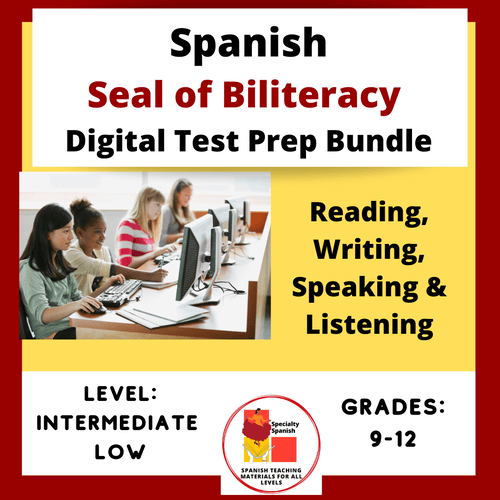
If you are looking for a complete roadmap to get your students through those high-stakes proficiency exams, Jamie’s Seal of Biliteracy Bundle is absolute gold! It moves beyond simple vocabulary and helps students move from "knowing" Spanish to being able to produce it spontaneously under pressure.
Who can use this product? This is designed specifically for secondary students in Year 3 and up who are aiming for those intermediate proficiency scores
What's included?
- Interpersonal Speaking/Listening: 15 pre-recorded audio prompts with rubrics and teacher scripts.
- Presentational Writing: 6 writing prompts that get progressively more challenging to build stamina.
- Interpretive Reading: 6 drag-and-drop activities (matching text to pictures and headlines to articles).
- Expert Guidance: Specific language on exactly what students need to do to hit that Intermediate 3 score required for the Seal of Biliteracy.
My Take: Why I find this bundle useful
Prepping for Spanish proficiency exams can be a marathon. I find this bundle particularly useful because it removes the guesswork for both the teacher and the student.
Full-Skill Coverage: Having Speaking, Reading, and Writing in one place makes it easy to simulate a real testing environment.
Intentional Scaffolding: Because the prompts get progressively harder, students build "linguistic muscle memory" rather than hitting a wall on day one.
Clear Targets: It defines exactly what an Intermediate 3 looks like, giving students a concrete goal to aim for.
The Zero-Prep Power Move: Picture Talk
When the clock is ticking and your prep time is disappearing, Jamie’s go-to is a Picture Talk (or Observar y Discutir). This is the ultimate "emergency" tool that actually feels like a planned, high-level lesson. It is ideal if you only have 15 minutes to prep.
One Way I’d do it in my classroom
A super easy way to facilitate a Picture Talk to get the most Spanish out of your students without any extra work on your part:
- The "Silent Minute": Project a compelling, culture-rich image (like a bustling image of Barcelona's La Boquería market or a vibrant piece of street art) and give students 60 seconds in silence to absorb the visual details before they have to speak.
- Scaffolded Questioning: Start with "Low-Floor" questions to build confidence (¿Hay un perro? ¿Es rojo o azul?). Then, layer in "High-Ceiling" questions (¿Qué pasó antes de esta foto? or ¿Cómo se siente la persona?).
- The "Write-Around": To wrap it up, have students write three sentences about the image. You can also have them pass their paper to a neighbor who has to add a fourth sentence starting with "Pero..." or "Porque..." to stretch their complexity.
Pro-Tip: If you want a structured tool to use for Picture Talks regularly, keep reading to grab my free graphic organizer below.
Why I love this idea
Let’s be honest: we’ve all had those mornings where the copier is jammed or the Wi-Fi is spotty. I love this "move" because it provides immediate Comprehensible Input without needing a single photocopy.
Teacher Wellbeing: There is zero grading and zero prep. It saves your precious minutes for the million other things on your to-do list while still providing a culture-rich experience for your students.
Reclaiming Your Weekends
If you feel like you are constantly taking work home, Jamie’s strategy is a simple but powerful shift in how you look at your school day.
"My best tip for reclaiming your weekends and work-life balance is to create a 'schedule' of how you use your planning time and protect it!"- Jamie
We´ve all watched a planning period disappear into a black hole of answering emails, chatting in the hallway (guilty!), or scrolling for "just one more idea." Instead of leaving your downtime to chance, Jamie suggest treating it like a sacred appointment.
By mapping out exactly how you'll use those minutes, you can get the must-dos finished during the week, so you don't have to carry them home on Friday afternoon.
Quick Tips for Work-Life Balance:
- Batch Your Brainpower: Group similar tasks. If you’re at the copier, do the whole week's worth. Switching gears is where we lose the most time!
- The "Good Enough" Resource: Don't spend hours hunting for a perfect authentic text. If you can’t find it in 15 minutes, use a "Picture Talk" image instead—your rest matters more.
- The Friday Shutdown: Make your Friday exit a hard deadline. Close the laptop at school; if it’s not done by 4:00 PM, it can wait until Monday.
A freebie from Jamie
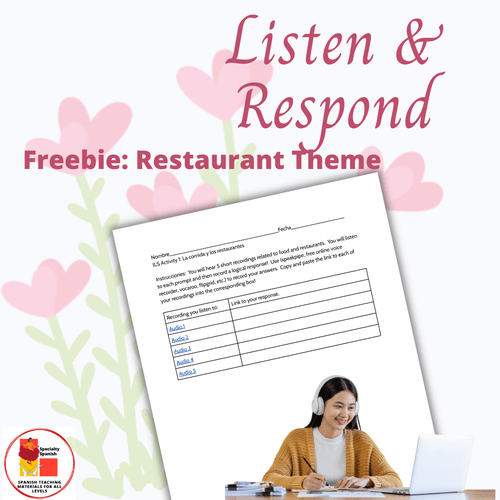
If you want to see exactly how this scaffolded approach works in practice, Jamie is sharing her Food and Restaurant Integrated Listening and Speaking activity. It’s the perfect way to test out the "no-lab" workflow with your students today.
A Freebie from Me: Picture Talk Graphic Organizer
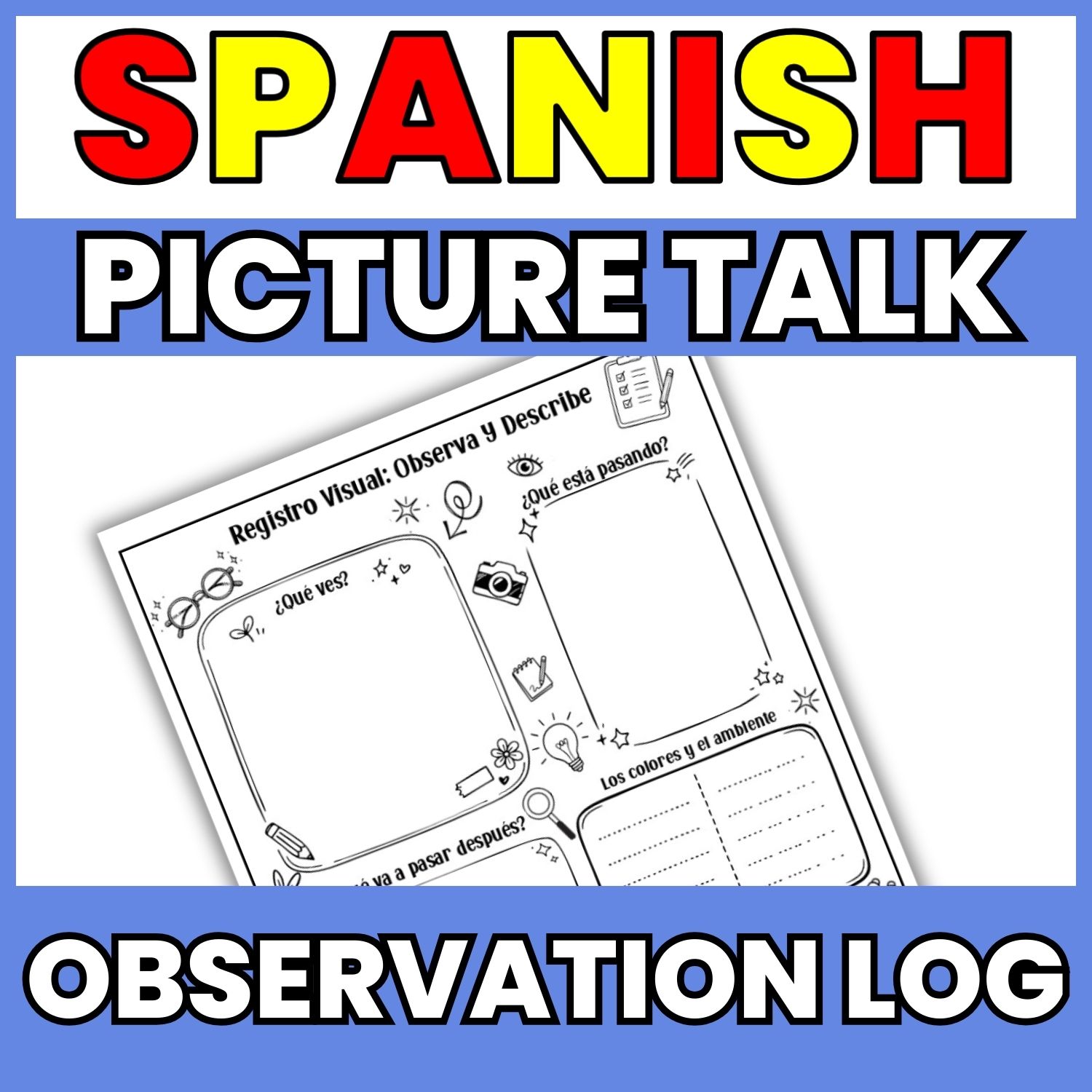
Since we just talked about the power of Picture Talks, I want to give you a tool to make your first one even easier. I’ve put together a Picture Talk Graphic Organizer that will help your students write and organize the details.
Instead of just having students shout out answers, this sheet gives them a structured place to "Observe, Think, and Wonder what's going to happen next" in Spanish.
The Lightning Round: Jamie's Quick Choices
Just as I did with La Señora Eller, I wanted to get Jamie’s quick take on a few classroom staples and a little travel inspiration:
- Go-to for real language? Movies and videos (always a hit with visual learners!).
- Brain break or movement? Power through (keep that momentum going!).
- New ideas from? Podcasts (perfect for multitaskers).
- Dream vacation: Summer in Spain or Winter in Argentina? Summer in Spain.
- The Big Debate: Tacos definitely win over Paella in her book!
Connect with Jamie
If you loved these ideas as much as I did, make sure to follow Jamie and see more of her high school resources over at her TpT Store: Specialty Spanish.
Final Thoughts on Systems and Balance
Moving toward a proficiency-based classroom doesn't have to mean sacrificing your time outside of school. Jamie’s approach shows that when you have a specific plan for your prep time and a few reliable go-to activities, you can maintain high student engagement without the constant "prep vortex."
I hope these strategies and resources give you back a few hours of your week. Using tools like the Picture Talk organizer or Jamie's ILS activity lighten your Spanish prep workload.
Want more low-prep Spanish resources?
I have a whole shop full of Spanish activities designed to save you time and keep your students engaged! Don't forget to visit and follow me!
0 comments