When February 14th rolls around, finding the right Spanish Valentine’s Day activities can feel like a chore—especially if you teach middle or high school. You want to acknowledge the day, but you also want to maintain your sanity and your curriculum. Finding secondary Spanish class ideas that don't feel "elementary" or overly sentimental is a challenge many of us face every year.
The good news? You can lean into the holiday energy without the glitter. By using structured Spanish speaking activities and intentional Spanish class games, you can turn a potentially chaotic day into one of the most productive speaking days of the quarter.
Let´s have a look!
More...
I have many different and fun Valentine's Day activities in my Spanish Worksheets and More store, you´re welcome to visit and check them out.
But in this post, I'm going to be showing you three simple, effective ways to keep your students engaged and using the target language. There´s a versatile dice breaker, a classic "find someone who," and a bingo game that focuses on vocabulary and will help you avoid the cringe factor in your Spanish Valentine's Day classes.
The "Reality Check"
Let’s be real: by the time students get to our room on February 14th, they’ve usually had enough sugar and "romance" to last them until next year. Trying to fight that energy with a traditional grammar lecture is a losing battle, but giving in to a "free day" feels like a missed opportunity.
So one thing you can do is use activities that are easy to prep or no prep and will get your students engaged from the word go as they practice their language skills in Spanish. That's what these activities bring to your class.
They require almost no setup, but they provide enough structure to keep the class from descending into chaos while still feeling festive and fun.

Disclosure: This post may contain affiliate links. As an affiliate for Amazon and other companies, I earn from qualifying purchases. This means that if you click on a link and make a purchase, I may earn a small commission at no additional cost to you.
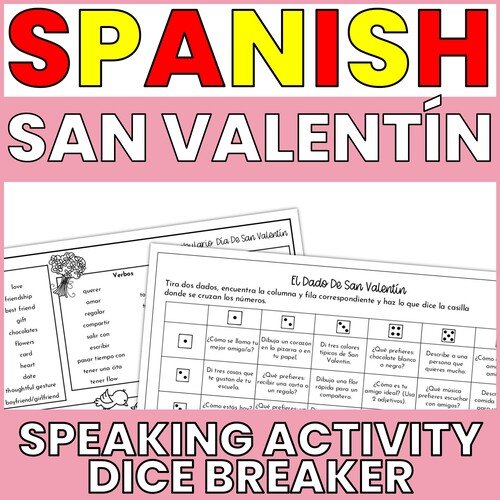
1. The Valentine’s "Dice Breaker"
This Valentine's Day Dice Breaker is a hit in Spanish class because it takes the pressure off the students. Instead of staring at a blank page or feeling awkward talking about "feelings," the dice decide the conversation.
How it works: Each number on the die corresponds to a specific question or prompt. For February 14th, I like to focus on El Día de la Amistad. Questions might range from "¿Qué prefieres chocolate blanco o chocolate negro?" to "¿Cómo se dice "I love you" en español?". Students sit in pairs or small groups, roll, and answer. It’s low-stress because the "game" element makes it feel less like an oral exam and more like a chat.
The Benefits: It builds fluency in a way that feels natural. Students are practicing spontaneous speech and active listening without even realizing it. Because the prompts are varied, they’re getting a workout in different verb tenses and vocabulary sets.
How to adapt it to your class: This game comes with two differentiated options, so you can focus on likes and dislikes and high frequency vocabulary with your lower grades or get your student susing more complex structures and vocabulary like "¿Qué harías por San Valentín si tuvieras un millón de dólares?" for more advanced groups. It also features a chat mat for extra support and a mini extension activity.
Find Someone Who - Día de San Valentín Edition: Moving and Mingling
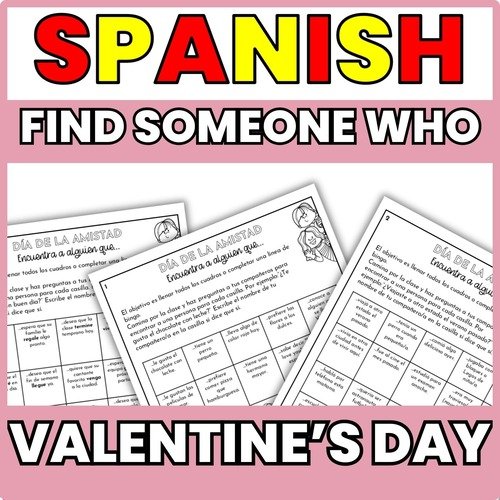
If your students are jittery, the best thing you can do is let them get up and move. A Valentine's-themed "Find Someone Who" (or Busca a alguien que...) is one of those Spanish activities that never fails to burn off energy while maximizing Student Talk Time (STT).
How it works: This is a total "print and play" activity—you just choose from version 1, 2, or 3 and hit print. Students move around the room with a "human bingo" sheet, asking their classmates questions. If a peer answers "Sí," they write that student's name down. The goal is to get a full grid while only speaking in the target language.
Why it works: It lowers the "affective filter" (that wall of teenage anxiety) because the focus is on the game, not on perfect grammar. But here is the best part: most of the questions aren't actually about romance. El Día de la Amistad is really just an excuse for students to find out more about their friends in Spanish class, which means no "cringe" moments for your middle or high schoolers!
How to use them in your class: I’ve included three differentiated versions to make planning easy:
Version 1: Perfect for Spanish beginners and middle schoolers to practice basic likes and dislikes.
Version 2 & 3: Designed for intermediate learners to tackle past tenses or even the subjunctive mode.
There’s even a mini-writing extension included for those early finishers who always seem to reach the "Bingo" mark five minutes before everyone else. It keeps them on task while the rest of the class finishes their conversations.
Valentine's Day in SpanishVocabulary Bingo: A Festive Cooldown
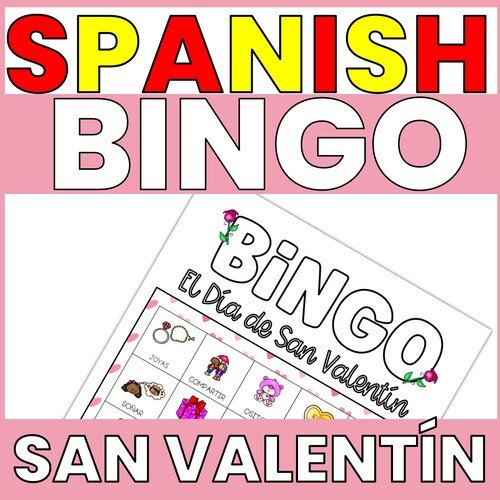
We can't talk about Spanish class games without mentioning Bingo. If your students already love playing Lotería, a round of Spanish Valentine’s Day Bingo is the perfect way to wrap up the period. It’s a high-engagement way to reinforce themed vocabulary without it feeling like a dry drill.
How it works: This is another "print and play" lifesaver. My version includes 36 different cards, so even your biggest classes are covered. You can choose the version with text to support your lower levels, or the version without text if you really want to challenge your Spanish 2 or 3 students to recognize the terms by sight.
The Benefits: It’s a fun way to get them comfortable with specific holiday phrases like bombones, cita romántica, enamorarse, and ramo de flores. Because it’s a game they already know how to play, there’s zero "ramp-up" time—you just hand out the boards and go. Plus, if you're avoiding the "glitter and glue" side of the holiday, this provides a festive atmosphere that still feels like a structured lesson.
Pro-tip for the busy teacher: This is a great "sub plan" backup or a quick warm-up. The set even includes printable counters, but if you want to be the "cool teacher," use conversation hearts as markers (just be prepared for them to disappear by the end of the round!).
Looking for more ways to bridge the gap between February 14th and Spring? If you’re still in the thick of the cold months, you might also like my Spanish Winter Activities blog post to keep your students focused while we wait for warmer weather, or head over to my Essential Spanish Festivals blog post to find out what the next festival is.
Wrapping Up a Stress-Free February 14th in Spanish Classs
Survival in a secondary Spanish class during a holiday is all about balance. You don't have to be the "anti-Valentine's" teacher, but you also don't have to sacrifice your curriculum for the sake of a party.
By using a mix of a Dice Breaker for small groups, a Find Someone Who to get them moving, and a Bingo game to settle them back down, you’ve covered all your bases: speaking, movement, and vocabulary building. You get to keep your sanity, and they get a day that feels special and "different" from the usual routine.
At the end of the day, El Día de la Amistad is just a great excuse to build community and get our students talking. And if you can do that with zero prep and zero glitter? That’s a win in my book.

0 comments